
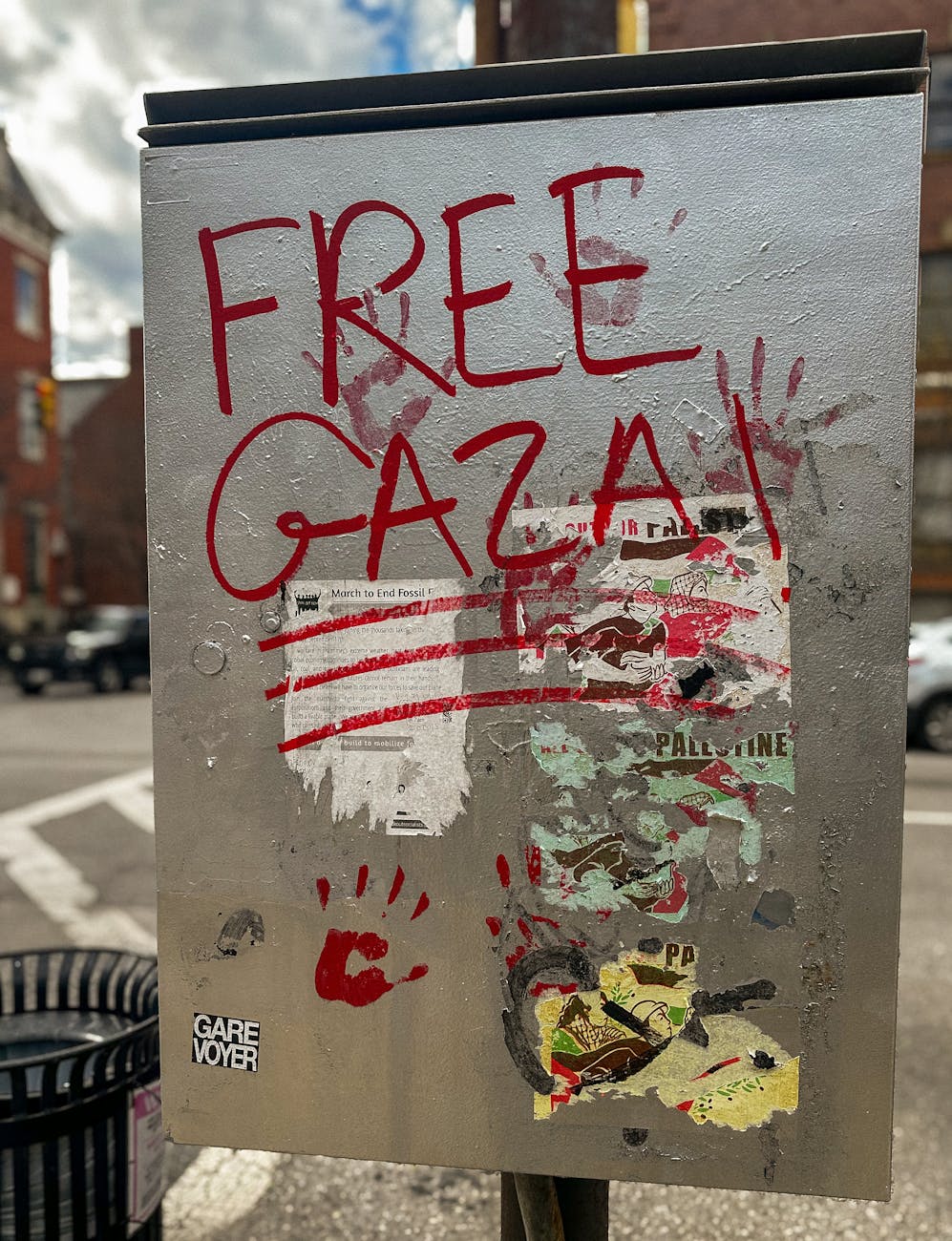
Gaza in Crisis (2010) is an crucial book that lays out the essential military and social engineering moves that have dominated the lives of Palestinians in Gaza, but also the West Bank, since 1948. The chapters are short and their style varied. What follows are some highlights from this essential book, but reading this masterful book is crucial for a nuanced and objective understanding of the conflict (I offer it as recommended reading in my new book Christians for a Free Palestine):
- The Ten Mythologies of Israel (Ilan Pappé)
- “Any attempt to solve a conflict has to touch upon its very core; the core, more often than not, lies in its history. A distorted or manipulated history can explain quite well a failure to end a conflict, whereas a truthful and comprehensive look at the past can facilitate a lasting peace and solution. A distorted history can in fact do more harm, as the particular case study of Israel and Palestine shows: it can protect oppression, colonization, and ocupation.” (5)
- 5 Myths Covered:
- 1) Palestine was a Land Without a People, Waiting for the People Without Land
- 2) Palestinians Resorted to Acts of Terror Against Jewish Settlers Prior to the Creation of Israel
- 3) Four Myths Around the Creation of Israel
- 4) Israel was a Benign Democratic State Prior to 1967
- 5) The Palestinian Struggle Has No Aim Other Than Terror
- 6) Israel Was Forced to Occupy the West Bank and Gaza in 1967, and Must Hold These Territories Until Others are Ready for Peace
- 7) Israel Occupied the West Bank and Gaza with Benevolent Intentions, But was Forced to Respond to Palestinian Violence
- 8) The Oslo Accords Reflected a Desire on Both Sides to Reach a Solution
- 9) The Second Intifada was a Mass Terror Attack Orchestrated by Arafat
- 10) A Solution in Israel and Palestine is Just Around the Corner
- The Fate of Palestine: An Interview with Noam Chomsky
- “the United States supports democracy if and only if it conforms to U.S. strategic and economic interests.”
- Clusters of History: U.S. Involvement in the Palestine Question (Ilan Pappé)
- “The first law, passed in 1946, stipulated clear regulations for lobbying, which a few years later would be violated, one by one, by AIPAC. The most important of them was the absolute prohibition on representing a foreign country.” (46)
- “what the Americans marketed as a peace plan was formula meant to satisfy the Israeli point of view.” (58)
- State of Denial: the Nakbah in Israeli History and Today (Ilan Pappé)
- “The Palestinian refugees spent the winter of 1948 in tent camps provided by volunteer agencies. Most of these locations were to become their permanent residences. The tents were replaced by clay huts that became a familiar feature of Palestinian existence in the Middle East. The only hope for these refugees at the time was the one offered by UN Resolution 194 (December 11, 1948), promising them a speedy return to their homes. This is one of many pledges made by the international community to the Palestinians that remains unfulfilled to this day.” (71)
- “The mechanisms of denial in Israel are very effective, because they are a comprehensive means of indoctrination, covering hte whole of a citizen’s life from the cradle to the grave. It ensures the state that its people do not get confused by facts and reality, or, at least, that they view reality in such a way that it does not create any moral problems.” (77)
- “Exterminate All the Brutes”: Gaza 2009 (Noam Chomsky)
- “Crimes of official enemies are subjected to rigorous investigation, but our own [in the U.S.] are systematically ignored. General practice, again, and understandable on the part of the masters, who rigorously adhere to a variant of the ‘too big to fail’ insurance policy granted to major financial institutions by Washington, which provides them with great competitive advantages in a form of protectionism that is protected from the usage of the unfavorable protectionism. The United States is just ‘too big to hold to account,’ whether by judicial inquiry, boycott and sanctions, or other means.” (102-3)
- “The claim that ‘our side’ never targets civilians is familiar doctrine in violent states. And there is some truth to it. Powerful states, like the United Staes, do not generally try to kill particular civilians. Rather, they carry out murderous actions that they are their educated classes know will slaughter many civilians, but without specific intent to kill particular ones.” (108)
- Blueprint for a One-State Movement: A Troubled History (Ilan Pappé)
- “The struggle over memory in the case of Palestine seems to be the most important task in this century for anyone committed to the Palestine case.” (142)
- Reframing the Israel-Palestine Conflict: “Israel is Not a Democracy” (Ilan Pappé)
- “Most people are now pushing the nonviolent strategy instead of the violent strategy for a change. This is good because I think a nwe reality that is going to be born out fo the nonviolent struggle will create a much better relationship at the time of reconciliation. If you win libeartion through violence, we know from other historical cases, you become a violent society yourself.” (162)
- The Ghettoization of Palestine: A Dialogue with Ilan Pappé and Noam Chomsky
- Chomsky: “But the critique of Israeli actions i s thin, because the basic facts are systematically suppressed. This is particularly true of the decisive U.S. role in barring diplomatic options, undermining democracy, and supporting Isreal’s systematic program of undermining the possibility for an eventual political settlement.” (164)
- Pappé: “the triangle of the U.S.-Israeli relationship has three equal legs–AIPAC, the military-industrial complex, and the Christian Zionists–and if one of them collapses, the whole structure crumbles.” (170)
- The Killing Fields of Gaza, 2004-2009 (Ilan Pappé)
- “Within the territories informally annexed to Israel, and those that might still be incorporated in the Jewish state, there is still a considerable number of Palestinians against whom, at the end of 2006, the Israeli authorities began pursuing a policy of a creeping transfer. Very little international attention has been paid to this de-Arabization of Jerusalem–too boring a subject for the Western media to bother with and too elusive for human rights organizations to make a general point about. There was no rush as far as the Israelis were concerned: they felt in the beginning of 2007 that they had the upper hand there. The daily abusive and dehumanizing heavy military and bureaucratic hands of the regime were as effective as ever in furthering the process of dispossessing Palestine.” (199)
- “It is the decision to employ such fierce military foce in civilian space that should be discussed. This kind of firepower can only produce the kind of horrific destruction we have seen in Gaza. It was used for this purpose. The nature of the military operations also displayed an Israeli military wish to experiment with new weapons, all intended to ill civilians as part of what the former chief of the army’s general staff, Moshe Ya’alon, termed as the need to brand in Palestinian consciousness the fearsome might of the Israeli army.” (211)
- A Middle East Peace the Could Happen (But Won’t) (Noam Chomsky)
- “The United States and Israel have been acting in tandem to extend and deepen the occupation.” (214)
- “The kinds of restrictions on movement used to destroy Gaza have long been in force in the West Bank as well, less cruelly but with grim effects on life and the economy.” (220)
- “Returning to reality, all these discussions about settlement expansion evade the most crucial issue about settlements: what the United States and Israel have already established in the West Bank. The evasion tacitly concedes that the illegal settlement programs already in place are somehow acceptable…What is in place already suffices to ensure that there can be no viable Palestinian self-determination.” (223)
- Interview with Noam Chomsky (Frank Barat)
 Christian Minus Christianity