
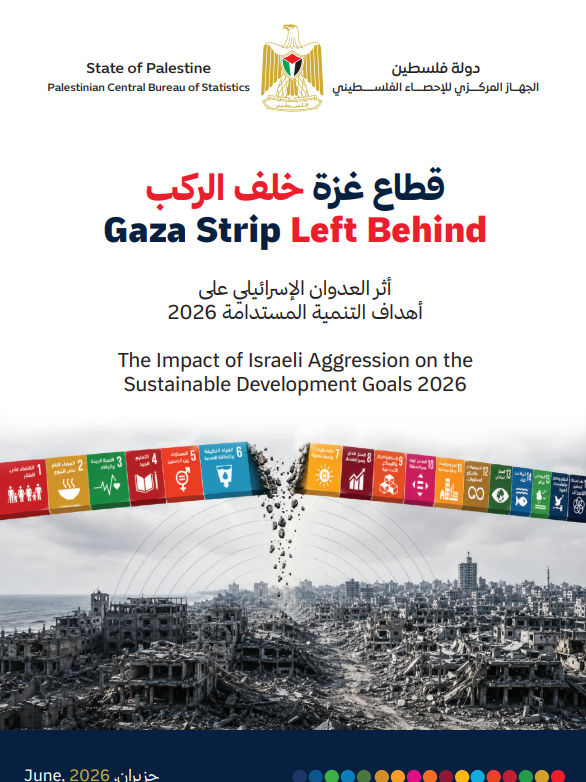
More than 1,000 days into Israel’s ongoing genocidal war on Gaza, the Palestinian Central Bureau of Statistics (PCBS) paints a grim picture: Gaza is not merely suffering a humanitarian crisis, but undergoing a systematic reversal of decades of development. In its June 2026 infographic, Gaza Strip Left Behind: The Impact of Israeli Aggression on the Sustainable Development Goals, PCBS says more than twenty years of development gains have been erased, pushing the Strip beyond poverty into famine and collapsing nearly every pillar of the Sustainable Development Goals.
What makes the report especially striking is that it does not describe isolated damage. It presents a complete developmental breakdown: food systems have collapsed, hospitals have been devastated, schools have been gutted, housing has been destroyed, and water, energy, and transport networks have been pushed to the edge of non-functionality. The result is a society forced to survive on emergency aid while losing the institutional and material foundations needed for recovery.
From poverty to famine
Before the war, PCBS says 64 percent of Gaza’s population already lived below the poverty line, reflecting years of siege and economic fragility. By 2026, the situation had worsened dramatically: 1.6 million people, or 77 percent of the population, faced acute food insecurity during October-November 2025, and famine was officially declared on 15 August 2025.
The collapse of agriculture is central to this outcome. PCBS reports that 98.5 percent of agricultural land in Gaza was destroyed or became inaccessible by 2025, making local food production nearly impossible. That destruction has been compounded by malnutrition among children and pregnant and breastfeeding women, with 101,000 children under five suffering from acute malnutrition by mid-October 2026 and 55,500 pregnant and breastfeeding women affected during 2025-2026.
UNEP’s environmental assessment supports this picture, noting severe damage to water systems, land, soils, and wastewater infrastructure, and warning that food production at scale is no longer feasible under present conditions.
Health system collapse
Gaza’s health sector has been pushed into near-total failure. PCBS says 36 hospitals were out of service as of 17 May 2026, representing 94 percent of all hospitals in the Strip. It also records 73,074 martyrs and 172,664 wounded people by that date, including 42,000 with severe injuries that permanently changed their lives.
The human cost is not limited to casualties alone. PCBS reports a dramatic drop in life expectancy, from 75.5 years before the aggression to 40.5 years during the period from October 2023 to September 2024. Maternal mortality also surged, rising from 17.4 deaths per 100,000 live births before the war to 145 in 2024.
These figures show that the crisis is not just about treating wounds after bombardment. It is about the destruction of the entire health ecosystem, from functioning hospitals and medicines to maternal care, emergency surgery, and rehabilitation. Once a health system reaches this level of collapse, preventable deaths multiply quickly, and recovery becomes vastly more difficult.
Education denied
PCBS describes Gaza as a place where an entire generation has been deprived of learning. About 95 percent of schools had been damaged in varying degrees by 21 April 2026, while 284 schools were completely destroyed, including 179 government schools and 105 UNRWA schools.
The consequences are immediate and long-term. Some 700,000 students were denied school education in the 2025/2026 academic year, and 88,000 university students were unable to continue their studies. In practical terms, this means interrupted childhoods, delayed graduations, broken career paths, and a severe loss of human capital that Gaza will feel for years.
Education is one of the Sustainable Development Goals most tied to recovery, resilience, and social stability. When schools are destroyed and universities are shuttered, the future is not just paused; it is actively dismantled.
Women and children
The war’s impact has been especially severe for women and children. PCBS says 60,000 pregnant women were left without healthcare in 2026, while 58,000 children had lost one or both parents by 18 July 2025. It also reports that 26,370 women were widowed, bringing the total number of widows in Gaza to 47,019 by 17 May 2026.
These numbers reveal a social emergency that goes beyond the battlefield. Family structures have been shattered, caregiving networks destroyed, and women increasingly pushed into single-handed survival under conditions of displacement, poverty, and trauma. PCBS’s finding that 26,370 new female-headed households emerged by March 2026 underscores how war has transformed social life itself.
The loss of protection, income, and healthcare has made women and children among the most exposed groups in Gaza’s collapse. This is not only a humanitarian issue; it is a direct setback to Sustainable Development Goals 5 on gender equality and every other goal linked to health, education, and decent living conditions.
Water and energy
PCBS says 97 percent of Gaza’s water became unfit for human consumption during the war period from 2023 to 2025, while daily per capita water access fell to just 3-5 liters, far below the humanitarian minimum of 15 liters. The report also notes that 700,000 linear meters of water networks were completely destroyed by 2025, 725 wells were put out of service, and 134 freshwater projects were targeted.
The energy situation is equally dire. PCBS reports that 80 percent of energy infrastructure was destroyed by 2025, including 5,080 kilometers of electricity networks and 16,266 solar energy projects. Gaza was also deprived of more than 2.1 billion kilowatt-hours of electricity by 5 October 2025, leaving hospitals, water systems, businesses, schools, and households in prolonged darkness.
UNEP similarly found that none of Gaza’s wastewater treatment facilities were operational and that water and sanitation failures were feeding contamination of groundwater, coastal waters, and the broader environment.
Economy and jobs
The economic collapse is just as severe. PCBS says unemployment exceeded 80 percent in 2024-2025, meaning roughly three out of four working-age people were out of work. Gross domestic product in Gaza fell by 84 percent in 2025 compared with 2023, while Gaza’s share of the Palestinian economy fell from 17 percent to 5 percent.
The productive base has been devastated. PCBS says 88 percent of commercial and industrial establishments were damaged by 2025, and 32,060 were completely destroyed. In a context where production has largely ceased, aid has replaced livelihoods, and economic activity is heavily constrained, the Strip has shifted from a fragile economy to an economy of dependency.
This collapse also matters politically and socially. Jobs are not only income; they are dignity, routine, and social inclusion. Their disappearance deepens poverty, weakens local institutions, and makes recovery harder with every passing month.
Housing and displacement
The scale of displacement is unprecedented. PCBS says about 2 million people have been displaced, the largest displacement crisis in two decades. It also reports that 268,000 housing units were completely destroyed by 17 May 2026, while 148,000 were severely damaged and rendered uninhabitable.
In addition, 833 mosques, 3 churches, and 208 heritage sites had been destroyed by 2025, showing that the assault has reached not only homes and hospitals but also cultural and historical landmarks.
The housing crisis is central to Gaza’s future. Without safe shelter, no family can rebuild stability, and no child can return to normal life. Displacement on this scale also intensifies overcrowding, disease risk, mental distress, and dependence on emergency aid.
Environment and future recovery
PCBS and UNEP both show that Gaza’s environmental damage is profound and long-lasting. The PCBS infographic states that rebuilding rubble and repair has already generated an estimated 60 million metric tons of carbon dioxide equivalent, while more than 45,000 bombs were dropped in the first 89 days of the war and over 200,000 tons of explosives had been dropped by October 2025.
UNEP warns that debris now exceeds 61 million tons and that restoration will require more than emergency cleanup. It calls for safe debris management, ecological risk screening, wastewater recovery, and science-based planning to restore land, soils, trees, water, and marine ecosystems.
That warning matters because the SDGs are not only about numbers; they are about the conditions that allow life to continue with dignity. Gaza’s environmental damage has become a direct threat to public health, food security, water safety, and long-term habitability.
What the Sustainable Development Goals (SDGs) mean now
Seen through the lens of the SDGs, Gaza’s crisis is not one-dimensional. It is a simultaneous collapse of SDG 1 on poverty, SDG 2 on hunger, SDG 3 on health, SDG 4 on education, SDG 6 on water and sanitation, SDG 7 on energy, SDG 8 on decent work, SDG 9 on infrastructure, SDG 11 on sustainable communities, SDG 13 on climate and environment, and SDG 16 on institutions and justice. PCBS explicitly frames the Strip as a place where development has been pushed backward by decades.
The deeper message of the report is that Gaza has been forced out of a development framework and into a survival framework. Humanitarian aid can prevent further death, but it cannot substitute for functioning institutions, productive livelihoods, safe water, education, healthcare, and reconstruction. That is why the PCBS report is more than a statistical summary: it is an indictment of a war that has targeted the very conditions required for development itself.