
B’Tselem
Occupied West Bank | August 14, 2026
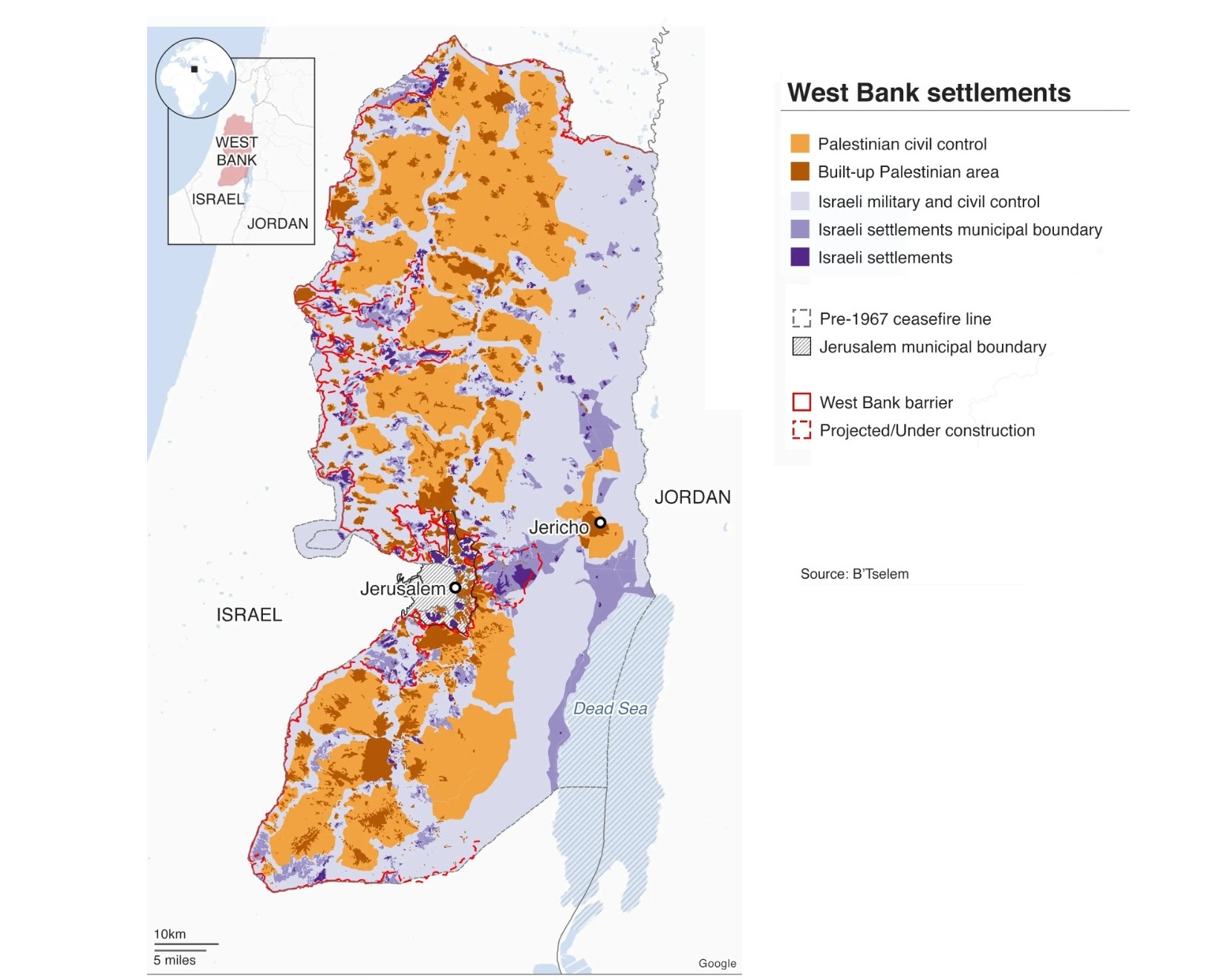
On 14 August 2026, Israeli Defense Minister Israel Katz ordered the Israeli army to draft a proposal to hand over law-enforcement responsibility in civilian cases of Israeli settlers and Israeli settlements in the West Bank from the army to the Israeli police. The plan reportedly calls for the creation of a dedicated police force and its empowerment and funding. Katz said the transfer was a measure to make sure that Israeli settlers in the occupied West Bank are treated more like Israeli citizens in other parts of Israel.
On a surface level, it looks like a mere shift in administrations between two Israeli security agencies. Its legal and political implications, however, could be much wider, especially if compared to previous Israeli acts that delegated some civilian functions from the military to civilian Israeli institutions in the occupied West Bank.
Why is this important to the law?
International law stipulates that the West Bank, including East Jerusalem, is occupied territory and that Israel is the occupying power. The International Court of Justice (ICJ) has again in its advisory opinion of 2024 held that the situation of occupation is not a permanent state of affairs, and that the occupying power cannot claim sovereignty over the territory being occupied. The Court also considered whether Israeli policies and practices constituted annexation, a permanent form of Israeli control of the occupied territory.
But the significance of the new decision is not merely the shift from the military to the police for law enforcement. The key question is over which institution is to be found to have the authority of government.
Israeli military operations in the occupied West Bank take place in the context of military occupation. The Israeli police, on the other hand, is a civilian state institution under the Ministry of National Security.
The removal of governmental authority from the hands of the military authorities and the transfer to ordinary Israeli civilian institutions can therefore, be taken as part of an ongoing process of integrating Israeli settlements and settlers into Israel’s civilian legal and administrative system.
This is not a legal determination of annexation. It is instead to be regarded as a further sign of de facto annexation, especially when combined with other land, planning, settlement and civilian administration related actions.
The Connection to the ICJ’s 2024 Opinion
It is a crucial issue as the ICJ has already discussed this issue in its advisory opinion, which was issued in 2024, in its examination of Israel’s transfer of certain civilian powers in Area C of the West Bank from military authorities to civilian authorities within Israel’s Ministry of Defense.
The Court viewed these changes in the context of other policies and practices which reinforce Israeli control over the occupied territory and which facilitate the integration of certain areas of the West Bank into Israel’s system.
In this context, the transfer of law enforcement from military to civilian control in 2026 should be viewed not just as a change in the administration of justice, but also as an extension of the same institutional trend.
The crucial point is whether such transfers have the effect of over time shifting the temporary military rule that characterizes occupation to permanent civilian rule by the occupying state.
To some degree, this is the case in all nations. In all countries this is the situation to a certain extent.
Another important issue is the existence of different legal systems for Israelis and Palestinians living in the occupied West Bank.
In its 2024 opinion, the ICJ pointed out that Israeli settlers living in the occupied West Bank are generally governed by Israeli civilian criminal law and civilian courts, while Palestinians, to a large extent, are governed by Israeli military orders and military courts.
The new decision could further cement this institutional divide. Israeli settlers would be subjected to increasing powers of Israel’s civilian police and legal system, while Palestinians in most of the West Bank would remain under a military legal system.
From the equality and non-discrimination point of view, this distinction is important. But not only do we have to determine which of the laws can be applied but which institutions are capable of investigating crimes, arresting perpetrators, and enforcing the law.
The civilianization of law enforcement from military to police also may heighten the impression of two systems working in parallel in the same area.
What about “Settler” violence against Palestinians?
The transfer also leaves an essential question hanging in the air: what will happen to Palestinian communities with regard to their protection from settler violence?
Switching the police force in charge of law and order does not remove Israel’s international responsibilities as occupying power. Israel continues under international law to have the duty to protect the civilian population in the occupied territory, and to prevent, investigate and prosecute serious acts of violence.
This implies that the military is not just supposed to be replaced by the police. In the case of settlers attacking Palestinian civilians, the appropriate Israeli authorities are still required to take effective steps to prevent such violence, and to investigate and prosecute the perpetrators.
In reality, the new deal will rely on the abilities of the police to make use of these powers, in particular in the context of Israeli settlers and Palestinian victims.
This is not a military or border police issue; this is a human issue.
Also, it is crucial to differentiate between the Israel occupation Forces (IOF) and the Border Police.
The Israeli military is a military institution of the ministry of defense in Israel. The Border Police, on the other hand, is part of the Israeli police and under the jurisdiction of the Ministry of National security. The two forces can work together in the West Bank, but have different institutional structures, legal frameworks and functions.
The Military is mainly responsible for military operations, and the Border Police is responsible for policing and security duties including crowd control, arrest and other law enforcement.
Transferring some tasks from the military to the police or Border Police, therefore, is not merely a replacement of soldiers with the police officers, it is an addition of other duties. It’s a shift in which arm of the Israeli state will hold the power to govern Israeli settlers in the West Bank.
The wider legal ramifications.
This is not the best way to describe this one decision, nor is it the most compelling legal argument. Rather, the importance is in the accumulation of the pattern.
The overall framework of governance may be increasingly shifting towards a permanent Israeli administration, as military authorities gradually give up control of law enforcement, land administration, planning, settlement policy and other civilian functions to Israel’s civilian institutions.
This difference is significant because international law contravenes the acquisition of sovereignty by an occupying power by mere extension of occupation, by changing its domestic administrative structures.
In its 2024 opinion, the ICJ highlighted the need to consider the overall impact of policies and practices, not just one specific decision.
Conclusion
Giving legal authority to the Israeli police instead of the Israeli military to handle law and order does not equalize a declaration of annexation of the West Bank. When taken together with the transfer of civilian powers, land and planning administration, settlement expansion, and the growing use of Israeli civilian institutions in Israeli settlements, however, it can also be seen as another clear sign of de facto annexation.
Whether it is the military or the police who will protect Israeli settlers is not the only question, though.
But the bigger question is whether the transfer of governmental powers from military to civilian domestic institutions is evolving from a temporary military structure into a more permanent one that is incorporated into the State of Israel, especially in the occupied territories.
The 2026 decision could be a major component of the greater legal history that will be reviewed to determine whether Israel has progressed from military government to permanent occupation of parts of the West Bank.